Impact Measurement Standard for Zoological Facilities
IMSZF.org
simon@imszf.org
Impossible data. Delivered at scale.
Tracking up to 1.000.000 visitors
New insights into behaviour, engagement, knowledge, and values will inspire new approaches to education in zoological facilities around the world.
Impossible data. Delivered at scale.
Tracking up to 1.000.000 visitors
Groundbreaking insights into visitor behaviour, engagement and knowledge, will inspire new approaches to education in zoological facilities around the world.
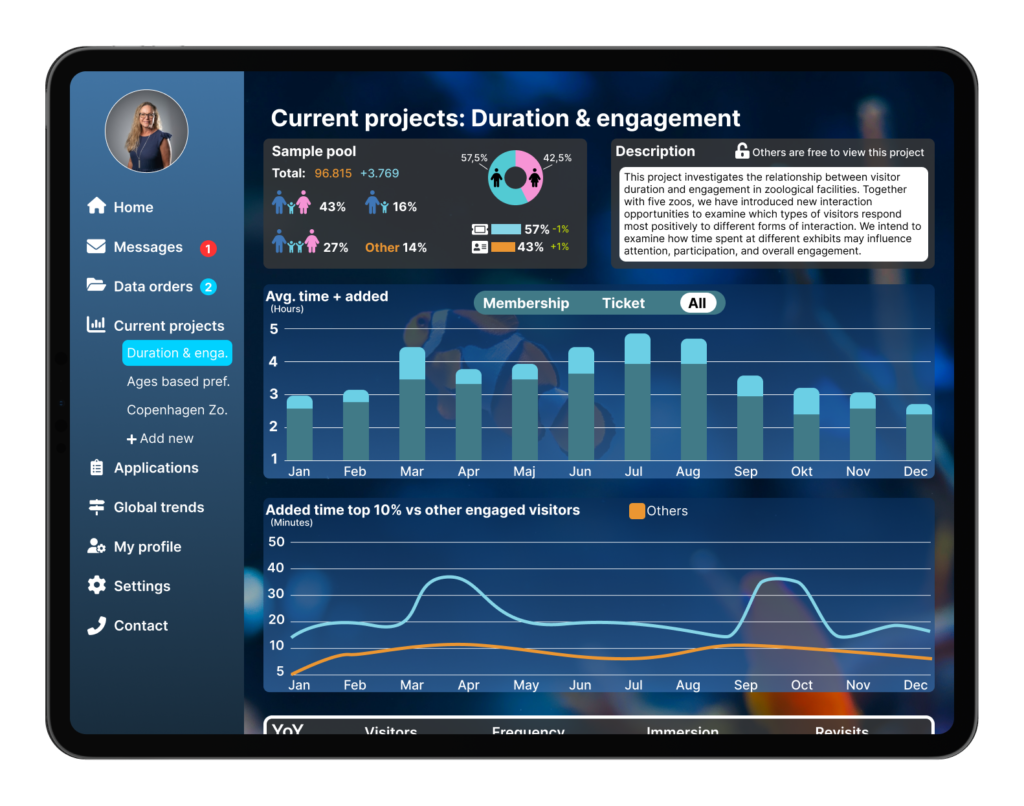
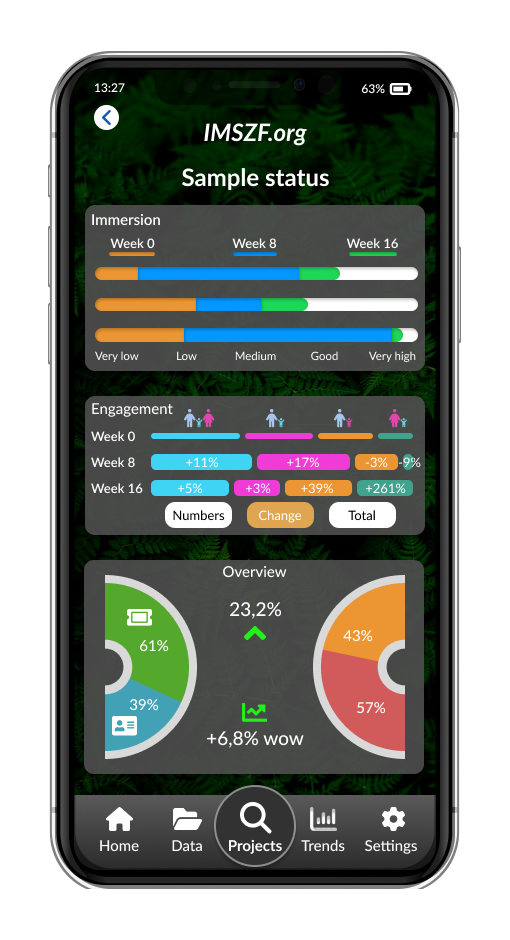
Live research insights, wherever you go
Keep track of multiple projects and follow live findings from your colleagues around the world, with data updated minute by minute.
Yearly and growing
Reach and impact
By solving the attribution problem and uncovering new insights into engagement preferences and real-world behavior, we can unlock new strategies and tools — laying the foundation for reshaping education worldwide.
+700.000.000
Global visitors
Impact projection
Denmark only
€30-70mio
Added domestically
300-600
Full-time equivalent years of employment
5-12%
Increase in visitors
€50-120mio
Total domestic value add
Inclusive & Net Positive
Over the course of five years, the project is expected to create significantly more value than it costs to fund. This net positive impact is driven by new approaches, closer and more meaningful partnerships, and engaging new visitors.
We are proud that this value is shared across all participating institutions, rather than concentrated in a single recipient of funding. This means every institution receives additional resources and tools to strengthen its public engagement, spark curiosity, and fulfil more of its educational and communication ambitions, rather than leaving that opportunity to just one.
Ultimately, this means reaching more children and families — helping them discover and care about animals and the natural world, while fostering a deeper understanding of the importance of conservation.
New apporach
Enabling new fields of research.
An innovative approach to measuring impact in zoological facilities opens new avenues for science, research, and discovery, enabling us to ask questions that were never before possible.
Take part in the research
Open Science

We believe data should be open to all. By following FAIR principles, we make data accessible and reusable for researchers worldwide.
Take part in the research
Open Science
We believe data should be open to all. By following FAIR principles, we make data accessible and reusable for researchers worldwide.
Key Research Takeaways
1.
Have the data come to you
No more starting from scratch every time you have new research questions. Get access to high-quality data tailored to the questions you want to explore — and, as the infrastructure grows, have the data you need available when you need it.
2.
Big Data
Higher-quality, richer and more consistent data will allow educators and researchers to understand what actually works, reproduce findings and continually refine the most effective approaches — laying the groundwork for global impact.
3.
A real-world laboratory
Test your theories across different facilities and observe how approaches perform in real-world settings — creating a test field that grows with every participating facility.
Denmark only
Zoological facilities
25
Estimated Families
350.000
Annual visitors
5.500.000
Visits from school-aged children
+1.000.000
Starting small
with record numbers
By rethinking the global approach to research, we open the door to new, larger and more complex research projects. For the first time, the approach has the potential to engage hundreds of thousands of voluntary participants and systematically track changes in guests’ knowledge and motivation over several years.
The potential impact is enormous. Not least because the approach can multiply the talent pool contributing to research. Where research today is often conducted by one or two researchers at a single facility, based on a single hypothesis, our approach creates the potential to involve thousands of researchers, keepers and educators across a large number of facilities. Each brings their own ideas, hypotheses and experience, which can be tested and compared systematically.
By simultaneously mapping research and educational approaches across facilities, we can build a much more precise understanding of what works, where it works, and which audiences respond best to different approaches.
This creates the foundation for new strategies, better communication and significantly greater overall impact — not only at individual facilities, but across the global zoological sector.
Go digital
Save months. Accelerate your research.
Replace time-consuming manual workflows with a faster, more reliable digital research process — so you can run more experiments, uncover new insights, and reproduce your findings.
Key Domestic Takeaways
1.
Net positive €30–70mio value added
New approaches to education drive engagement and attract more visitors — while creating new partnerships that unlock further investment in better facilities and an ever-growing foundation for education.
2.
Everyone is invited
An inclusive methodology enables every zoo, aquarium and similar facility to participate — transforming global research from a single location into an unlimited network, and giving everyone the tools and knowledge to improve their educational offerings.
3.
Center for global zoo-science based in Denmark
Building the foundation for a global hub of groundbreaking insights and knowledge sharing — pioneering new methodologies and approaches to engage visitors of all ages and shape core values for the future.
Higher visitor numbers mean greater impact… Right? …Right?
Why change matters for philanthropic foundations
Stop mistaking visitor numbers for impact.
Visitor numbers reflect hype, marketing, location and convenience.
Impact reflects engagement, investment and long-term vision.
Use evidence from a zoo’s past and current projects to strengthen your decision-making. See what previous investments have achieved, how ongoing projects are performing, and use measurable impact to inform future funding decisions.
Innovative research infrastructure
Our resources provide the insights and evidence needed to advance research that is currently hindered by methodology, selection bias, geography, and budget constraints.
Imagine what you could discover with data from more than one million visitors, tracked over four years across behaviour, knowledge, and interests?
Beyond
- Selection bias
- Before-and-after studies
- Self-reporting
- Single visit studies
- Short-term motivation
- Prior knowledge
Understanding the problem
For decades, researchers have worked within the limits of what could realistically be measured. We ask people what they think, feel and remember. We study relatively small groups. We observe behaviour within controlled settings or for limited periods of time. These approaches have generated important knowledge — but they also leave vital gaps in our understanding.
What happens when we can observe more, measure more and follow people over time? We believe the next step is not simply more research, but better opportunities to conduct research — complementing existing approaches with richer real-world data and making previously inaccessible questions possible to explore.
What to study?
What do you want to know?
Learning
Education
Psychology
Conservation
Behavior
Visitor Experience
Sociology
Willingness to donate
How does understanding of nature develop?
Which forms of communication and engagement are most effective?
How do repeated experiences influence interest and values?
When do attitudes towards biodiversity change?
What motivates visitors to return?
What makes a visit to one facility inspire visitors to visit another?
How do groups influence one another?
How do children influence their parents’ willingness to support conservation?
Where We Are Today
1.
Very positive pilot feedback
Can easily be integrated into multiple facilities at minimal cost, solving shared challenges that prevent researchers, visitors and zoological facilities from reaching their full potential.
2.
Looking for partnerships in science
The first step is to map out as many ideas and data needs as possible, making sure everything is considered from day one. Tell us what you need — and what you need it for.
3.
Seeking philanthropic funding partners
You want your investment to create meaningful, measurable impact. We help you see where it makes a difference — and build the evidence to prove it.
Are you the right match?
You don’t have to be perfect
Funding Partner
We welcome foundations, philanthropists, and organisations who want to support the development of a research infrastructure that enables new knowledge and addresses some of the challenges shaping our future.
Whether your focus is biodiversity, climate, children and future generations, or other global challenges, your support will help create a unique research infrastructure and enable researchers around the world to ask new questions, generate new knowledge, and share their findings with more people.
Together we can turn your support into measurable impact — with the data and evidence to show what works and why.
Funding Partner
We welcome foundations, philanthropists, and organisations who want to support the development of a research infrastructure that enables new knowledge and addresses some of the challenges shaping our future.
Whether your focus is biodiversity, climate, children and future generations, or other global challenges, your support will help create a unique research infrastructure and enable researchers around the world to ask new questions, generate new knowledge, and share their findings with more people.
Together we can turn your support into measurable impact — with the data and evidence to show what works and why.
Research Partner
For researchers who want to test hypotheses, replicate findings, explore new questions, or investigate areas that are not possible to study today.
Whether you want to be hands-on and help develop new methods, build collaborations and advance the research infrastructure — or simply access and analyse the data you need from your own desk, you can help shape what comes next.
We invite you to develop new research projects, contribute your expertise, or explore the available data independently and share your findings with the wider research community.
Research Partner
For researchers who want to test hypotheses, replicate findings, explore new questions, or investigate areas that are not possible to study today.
Whether you want to be hands-on and help develop new methods, build collaborations and advance the research infrastructure — or simply access and analyse the data you need from your own desk, you can help shape what comes next.
We invite you to develop new research projects, contribute your expertise, or explore the available data independently and share your findings with the wider research community.
Zoo or aquarium? Everyone is invited to join.
Partner facility
We are building a network of zoological facilities committed to education, learning and meaningful visitor experiences. Whether you already invest in education, run school programmes, have experience with philanthropic funding, or are looking to unlock new opportunities, there is a place for you.
We are starting in Denmark — and building towards a global network. As funding grows, more countries and facilities will be invited to join. Want your country to be next? Connect with your local philanthropists and help make it happen.
Zoo or aquarium? Everyone is invited to join.
Partner facility
We are building a network of zoological facilities committed to education, learning and meaningful visitor experiences. Whether you already invest in education, run school programmes, have experience with philanthropic funding, or are looking to unlock new opportunities, there is a place for you.
We are starting in Denmark — and building towards a global network. As funding grows, more countries and facilities will be invited to join. Want your country to be next? Connect with your local philanthropists and help make it happen.
What would you test if you had the opportunity?
Apply today
Keep it simple, clear, and concise.
1–2 pages will suffice. Tell us:
- Who are you?
- What data would you like to have available in one, two, or five years?
- What would you like to test, and what are you hoping to find out?
- Who will benefit, and how — the facility, children, educators, or others?
Ultimately, your research is made possible by generous philanthropists and foundations. Make it easy for them to approve.

Sarah J, Cambridge University
Today at 11:23
Dear all,
Do you have any data available on visitor frequency, group composition, and engagement preferences? Specifically, families with children under 12.
I want to test a hypothesis about the relationship between engagement preferences, long-term knowledge transfer, and changes in charitable donations.
Regards,
Sarah
Hi Sarah,
Good to hear from you again.
Of course we do 🙂
Would you like to have it adjusted for membership status, top performers, certain visitor patterns, charitable amounts, growth in charitable amounts by group, or something else?
We have it all.
I’ll take it all — thank you.
Why do I feel like you’re always three steps ahead?
Thank your colleagues all over the world for their insatiable thirst for more insights. You’re all contributing pieces to a gigantic puzzle.
Just log in. Your data will be waiting in the data-order folder in two minutes.
See you at the convention.
The Why
“Honestly… I just want my kids to be smarter than I am.
That’s one of the reasons we’ve visited our local zoo more than 200 times and also have season passes to the national aquarium. But despite attending everything they have to offer, no specific knowledge seems to stick.
And it’s not just us — everyone we know says the same thing.
So either it’s us and everyone we know… or the current engagement strategies need to be reevaluated.
By mapping things like engagement, knowledge retention, and changes in behaviour, zoos, aquariums, and similar facilities could approach their engagement strategies like the world’s leading Fortune 500 companies do.
Plus, proof of impact is exactly what’s needed for the zoos to attract and engage business partners and philanthropic investors. Which would lead to additional financial resources, stronger engagement, new enclosures, spikes in curiosity, and ultimately… my kids being smarter than I am.”
Leave an impact
Whether through grants, donations or impact investment, move from hoping your support makes a difference to measuring and demonstrating the impact it creates and how it changes over time.
For foundations and impact investors already investing in education, zoological facilities, children, conservation and related causes, our infrastructure provides the opportunity to measure what works, document the outcomes and build stronger evidence for future investments.